Here's my scribe post in a video.
Thanks for reading/watching. The next scribe is going to be ADRIAN. Oh and, don't choose me or Peachy for scribe, because we already have 4 or something, so yeah.. Anyways, hope you understand fractions, and comment if I should change anything.
Showing posts with label dean841. Show all posts
Showing posts with label dean841. Show all posts
Pythagoras
Apparently, Mr. Harbeck slipped on ice and bumped his head. Trust me, it happens everywhere in the winters of Winterpeg. That accident has caused him to have amnesia. Now, as a class, he needs us to explain the artifacts he found in his backpack.
-NOTE- Pay attention to the words that are PURPLE because those words are related with the artifacts found with Mr. Harbeck.
1st Artifact
 This shape is called a right angle triangle, R.A.T. for short. The bottom left corner is a right angle, or a 90 degrees angle. The lines connected to it are called legs. These legs are usually labeled "A", and "B". "A" is usually the one that stands upright because it stands for altitude, and "B" is usually on the bottom because it stands for base. However, it doesn't matter, it could work either ways. The longest side of the triangle is called the hypotenuse, and labeled side "C". You could find the hypotenuse across from the right angle. The two angles connected to the hypotenuse are labeled Theta and Beta. These two angles added together equal 90 degrees. That makes those two angles called complimentary angles.
 2nd Artifact
This artifact is called a square. What makes it a square is the lines of symmetry. The lines of symmetry are the lines that go through each side of a square. This indicates that all sides of the square is equal. Each corner of a square is 90 degrees angle. If you add up all of the corners you will get 360 degrees. Which means that this square is 360 degrees. If you cut this square in half from corner to corner, you will have two R.A.T.'s.
3rd Artifact
 This is the pythagorean theorem. It was created by a guy named Pythagoras. I will talk more about him soon. Anyways, he came up with this equation to find the unknown side of a right angle triangle. Say we know side A, and B of a triangle. What we wanted to find out was C. All we have to do is use the pythagorean theorem. First we square side A and B. Next you add both of them up. And lastly, you find the square root of the sum on the left side, and you find the square root of the C squared on the other side. The number that your left with, should equal to side C.
4th Artifact
 This is a statue of the famous Pythagoras. This is a Greek man that created the pythagorean theorem. He also came up with many other conclusions and theories. Because of this, he is often called the father of math. He figured out that the earth revolves around the sun, and the circumference of the earth. He spent a lot of time in Egypt, and he was the only westerner to be buried in a pyramid. He was also fluent in Egyptian language. Another interesting fact was that Pythagoras was a vegan. A vegan is someone that only eats non-living things.
Here are the two videos Joseph, Adrian and I made.
Thanks for reading and watching, please comment if I missed anything. Thanks and goodbye!
-NOTE- Pay attention to the words that are PURPLE because those words are related with the artifacts found with Mr. Harbeck.
1st Artifact
 This shape is called a right angle triangle, R.A.T. for short. The bottom left corner is a right angle, or a 90 degrees angle. The lines connected to it are called legs. These legs are usually labeled "A", and "B". "A" is usually the one that stands upright because it stands for altitude, and "B" is usually on the bottom because it stands for base. However, it doesn't matter, it could work either ways. The longest side of the triangle is called the hypotenuse, and labeled side "C". You could find the hypotenuse across from the right angle. The two angles connected to the hypotenuse are labeled Theta and Beta. These two angles added together equal 90 degrees. That makes those two angles called complimentary angles.
 2nd Artifact
This artifact is called a square. What makes it a square is the lines of symmetry. The lines of symmetry are the lines that go through each side of a square. This indicates that all sides of the square is equal. Each corner of a square is 90 degrees angle. If you add up all of the corners you will get 360 degrees. Which means that this square is 360 degrees. If you cut this square in half from corner to corner, you will have two R.A.T.'s.
3rd Artifact
 This is the pythagorean theorem. It was created by a guy named Pythagoras. I will talk more about him soon. Anyways, he came up with this equation to find the unknown side of a right angle triangle. Say we know side A, and B of a triangle. What we wanted to find out was C. All we have to do is use the pythagorean theorem. First we square side A and B. Next you add both of them up. And lastly, you find the square root of the sum on the left side, and you find the square root of the C squared on the other side. The number that your left with, should equal to side C.
4th Artifact
 This is a statue of the famous Pythagoras. This is a Greek man that created the pythagorean theorem. He also came up with many other conclusions and theories. Because of this, he is often called the father of math. He figured out that the earth revolves around the sun, and the circumference of the earth. He spent a lot of time in Egypt, and he was the only westerner to be buried in a pyramid. He was also fluent in Egyptian language. Another interesting fact was that Pythagoras was a vegan. A vegan is someone that only eats non-living things.
Here are the two videos Joseph, Adrian and I made.
Thanks for reading and watching, please comment if I missed anything. Thanks and goodbye!
Scribe Post for January 26, 2009
Today in class, we went over some word problems. The word problems that we did, are located on pages 44, 45, and 46 of your purple booklet. In this scribe I will show 3 word problems, and I will explain a little bit of each, so that it makes it easy for you to do.
When you have a word problem, you must answer the word problem with the last sentence from the problem. For example: If the last sentence of a question is "Find the number", then your answer would be "The number is ____". Something like that. There is always numbers in the questions, you just have to find them. Try looking for the variable first, and then the constant. I find it easier for me.
BLUE = The variable in word problem
GREEN = The constant in word problem
RED = The operation (What you're doing to the constant.)
PINK = The answer in word problem
____________________________________
First Question :
Page 44, #15
The sum of eight times a number and fifteen is seven. Find the number.
The number is __
Bring down all of the numbers that you could identify, and this question should look like this.
8n + 15 = 7

The number is -1
REMEMBER - always end your word problem with a sentence solving the question.
For this question, the sentence is right above.
Second Question
Page 45, Letter N
Mo is thinking of a number. Eleven more than one third of the number is -1. Find Mo's number.
n/3 + 11 = -1

Mo's number is -36.
Third Question
Page 45, Letter T
NOTE - Some questions will make it harder for you to find the numbers, but just relax, and take time to find them all.
Mr. Piper's plumbing needed repairs. The plumber charged $98 for parts plus $45 per hour for labor. If the bill totaled $458, how many hours of labor were required?
45h + 98 = 458

8 hours of labor was required.
_____________________________________
Anyways, thanks for reading. And sorry for doing such a bad job, I had to rush most of these.
The next scribe is JAYZIE.
COMMENT!
When you have a word problem, you must answer the word problem with the last sentence from the problem. For example: If the last sentence of a question is "Find the number", then your answer would be "The number is ____". Something like that. There is always numbers in the questions, you just have to find them. Try looking for the variable first, and then the constant. I find it easier for me.
BLUE = The variable in word problem
GREEN = The constant in word problem
RED = The operation (What you're doing to the constant.)
PINK = The answer in word problem
____________________________________
First Question :
Page 44, #15
The sum of eight times a number and fifteen is seven. Find the number.
The number is __
Bring down all of the numbers that you could identify, and this question should look like this.
8n + 15 = 7

The number is -1
REMEMBER - always end your word problem with a sentence solving the question.
For this question, the sentence is right above.
Second Question
Page 45, Letter N
Mo is thinking of a number. Eleven more than one third of the number is -1. Find Mo's number.
n/3 + 11 = -1

Mo's number is -36.
Third Question
Page 45, Letter T
NOTE - Some questions will make it harder for you to find the numbers, but just relax, and take time to find them all.
Mr. Piper's plumbing needed repairs. The plumber charged $98 for parts plus $45 per hour for labor. If the bill totaled $458, how many hours of labor were required?
45h + 98 = 458

8 hours of labor was required.
_____________________________________
Anyways, thanks for reading. And sorry for doing such a bad job, I had to rush most of these.
The next scribe is JAYZIE.
COMMENT!
Pay It Forward
For my assignment, I am going to help my family, or even people that I don't even know. I might shovel a yard, or even volunteer somewhere. I could be doing a good deed in the piercing cold winds, or by helping people in the comfort of a warm home. I will be doing this throughout my winter break. Whatever I end up doing, I know it will help, and I hope it continues so I could truly make a difference.

__________________________________________

_______________________________________


As you can see, for my good deeds, I shoveled snow, twice actually, and I masqueraded as Santa. First off, I was only suppose to shovel once. So I shoveled this stranger's backyard. It turned out to be quite tiring, but it was worth it, knowing that I (hopefully) made someone happy. Then, the next day, there was a terrible snowstorm. The snow was plenty of inches high, and I knew that I had to shovel more. When I got home, I saw that my mom's driveway was engulfed in snow. Out of kindness, I decided to clean it up. I even got my cousin to take pictures of me. Just when I thought I was done, I was reminiscing about this winter break. If there was any other good deeds that I did without me knowing. And then it came to me. I remembered about Christmas Eve, when I dressed up as Santa. I know it doesn't seem like a good deed, but when you actually try it, you know that it is. Being Santa made my family's Christmas a whole lot better. It brought us that Christmas spirit that were too old enough to bring out. It was pretty fun, and it made my family smile a lot. When I did these deeds, it made me feel incredible. Knowing that I am going to help someone just means a lot. Although, I did not ask any of these people to pay it forward, except for my mom (who was actually pretty happy that I shoveled). The reason why I didn't ask them to pay it forward was because, knowing that someone made them smile would probably mean more to them, than someone telling them to do something.
One person, could do a lot of things. Just think of all the people that helped our world. They probably didn't do what they did because they were told to, they probably did it because they wanted to. And that's what pay it forward is all about. One person, making a difference. Not because he has to, but because he wants to.
Thanks for reading, and please comment!


As you can see, for my good deeds, I shoveled snow, twice actually, and I masqueraded as Santa. First off, I was only suppose to shovel once. So I shoveled this stranger's backyard. It turned out to be quite tiring, but it was worth it, knowing that I (hopefully) made someone happy. Then, the next day, there was a terrible snowstorm. The snow was plenty of inches high, and I knew that I had to shovel more. When I got home, I saw that my mom's driveway was engulfed in snow. Out of kindness, I decided to clean it up. I even got my cousin to take pictures of me. Just when I thought I was done, I was reminiscing about this winter break. If there was any other good deeds that I did without me knowing. And then it came to me. I remembered about Christmas Eve, when I dressed up as Santa. I know it doesn't seem like a good deed, but when you actually try it, you know that it is. Being Santa made my family's Christmas a whole lot better. It brought us that Christmas spirit that were too old enough to bring out. It was pretty fun, and it made my family smile a lot. When I did these deeds, it made me feel incredible. Knowing that I am going to help someone just means a lot. Although, I did not ask any of these people to pay it forward, except for my mom (who was actually pretty happy that I shoveled). The reason why I didn't ask them to pay it forward was because, knowing that someone made them smile would probably mean more to them, than someone telling them to do something.
One person, could do a lot of things. Just think of all the people that helped our world. They probably didn't do what they did because they were told to, they probably did it because they wanted to. And that's what pay it forward is all about. One person, making a difference. Not because he has to, but because he wants to.
Thanks for reading, and please comment!
The Great Big Book of Algebra
Chapter One :
Adding Integers - Haiku
Combining Digits,
A number line is the key,
Sum is the answer.
Subtracting Integers - Free Verse
Take away from that,
That is what you call subtract.
Instead, change the line,
add the opposite is fine.
and maybe even better,
do the rest and you are done.
Partitive Division - Tanka
Use equal parts here,
Imagine dealing out cards.
Give some to each group.
Make sure it's equal,
That is the answer.
Quotative Division - Free Verse
Peek-A-Boo, I see you.
Find me in, a number bin.
How much of me, can you see.
Circle me how many times,
Don't worry it's not a crime.
The number of me,
Is your answer you see.
Ron's Rule - Free Verse
Ron's rule isn't hard,
Just use when multiplying.
Negative numbers,
Odd is Negative,
And just vice versa.
Thanks for reading and here's a little extra since I put this off to the last minute.
Hope you enjoy.
Chapter 2 :
Combining Like Terms and the Distributive Property.
Pog: Hey
Adalrico: Hello. How may I help you?
Pog: I'm kind of low on money as you can see from my clothes, so I was wondering if you could make me a bank account.
Adalrico: Surely I could do something. Although, in order to obtain an account, you must go through a series of questions. It's a new policy that the manager has created.
Pog: Yeah whatever, as long as I get my account. I haven't eaten in days you know.
Adalrico: Well the first question isn't that hard, and if you graduated in school, you should answer this easily.
Pog: Alright then.
Adalrico: The first question is "n+ 3 -5n +12"
Pog: Algebra huh? That rhymed, im a poet and I didn't know it.
Adalrico: Please, just answer the queastion.
Pog: Well, I remember something about this in school. Maybe if I bring the N and -5n together, so then if i have negative 5 n's, and I add the other n, that would equal to negative 6 n's (-6n). Is that right so far?
Adalrico: Just continue and I'll tell you once you get your complete answer.
Pog: Fine then. So now, I'm left with -6n +3 +12. This part is easy, I just add the 3 and 12 to get 15. So my complete answer is now, -6n +15. Is that right?
Adalrico: I'm sorry sir, but that is incorrect.
Pog: What!? Show me then if your so smart.
Adalrico: Well, the last part you did was right, the part where you got positive 15. The part where you got wrong was when you were adding the variable.
Pog: Very what?
Adalrico: The variable, the unknown number. The n.
Pog: Oh okay, so how do I do it then?
Adalrico: Well sir, as you can see, there is no negative sign in front of the n. Although, there is a negative sign in front of the 5n. So, it's a simple addition question. Add 1 positive n to 5 negative n's. What would that equal?
Pog: Uh, it would equal a number.
Adalrico: Wow, it's very simple. That equation would equal to negative 4 n's (-4n).
Pog: So the right answer would be -4n +15?
Adalrico: Precisely.
Pog: I knew it! Well, kind of.
Adalrico: Well Pog, you could still get your bank account, but you would have to answer at least one question right. Would you like another question?
Pog: Bring it on then, I'm prepared for anything you give me.
Adalrico: Very well then. Your next question is 2 +4(3n +8).
Pog: Umm, hold on, let me try and remember what to do if there is brackets. I got it! When a bracket is touching a number, you multiply the two. So 4 multiplied by 3n. I think that would equal to 12n! Now that the brackets are gone, I'm left with 2+12n+8. Since I can't add the 2 to the 12n, I add it to the positive 8. So then, that would equal positive 10!
Adalrico: Once again, you are wrong.
Pog: Are you for real?
Adalrico: Sadly, yes. You messed up when you saw the brackets. It's true that you multiply when a number is touching a bracket, but in this case, we will use the Distributive Property.
Pog: Okay then, but how does it work?
Adalrico: When a number touches a bracket, the number outside of the bracket multiplies the numbers inside the brackets. So since the number touching the bracket is +4, and one of the numbers inside of the brackets is 3n, we multiply those two.
Pog: So it would be positive 4 multiplied by 3n right?
Adalrico: Exactly, now your getting the hang of it. Do you know the answer to that?
Pog: Well, if I have 4 groups of 3n's, then I would end up with 12n's! Right?
Adalrico: Yes, now since there is one more number inside of the brackets, you multiply the four with that number inside.
Pog: So, since a positive 8 is still in the brackets, you multiply that with the positive 4. Am I correct?
Adalrico: Of course. That would equal what Pog?
Pog: Uhmm, 4 groups of positive 8 would equal, 32!
Adalrico: Correct once again. Now tell me the all the integers you have so far.
Pog: 2 +12n +32. Just like the first question, I add the same type of numbers. Since the 12n doesn't fit in with anything else, I add the other two integers.
Adalrico: So then the integers you're adding are 2 + 32.
Pog: Finally, an easy question. 2+32 would simply equal 34.
Adalrico: Do you know what to do next?
Pog: Of course, you put the two integers together and create an expression.
Adalrico: And that expression would be?
Pog: It would be positive 12n +34.
Adalrico: At last, you come up with the right answer. Even if you made mistakes, but we'll forget about that. Have you learned from your mistakes?
Pog: Yeah, now may I have my bank account, I'm getting pretty hungry.
Adalrico: Haha, sure. There, your all ready to go.
Anyways, I made two videos because my script couldn't fit on one movie.
Thanks for watching, and please comment!
Chapter Three :
is not yet done, but I'll finish this ASAP.
Chapter Four :
Here's the video that Adrian, Clarence and I made. Sorry for not describing it enough.
Adding Integers - Haiku
Combining Digits,
A number line is the key,
Sum is the answer.
Subtracting Integers - Free Verse
Take away from that,
That is what you call subtract.
Instead, change the line,
add the opposite is fine.
and maybe even better,
do the rest and you are done.
Partitive Division - Tanka
Use equal parts here,
Imagine dealing out cards.
Give some to each group.
Make sure it's equal,
That is the answer.
Quotative Division - Free Verse
Peek-A-Boo, I see you.
Find me in, a number bin.
How much of me, can you see.
Circle me how many times,
Don't worry it's not a crime.
The number of me,
Is your answer you see.
Ron's Rule - Free Verse
Ron's rule isn't hard,
Just use when multiplying.
Negative numbers,
Odd is Negative,
And just vice versa.
Thanks for reading and here's a little extra since I put this off to the last minute.
Hope you enjoy.
Chapter 2 :
Combining Like Terms and the Distributive Property.
Pog: Hey
Adalrico: Hello. How may I help you?
Pog: I'm kind of low on money as you can see from my clothes, so I was wondering if you could make me a bank account.
Adalrico: Surely I could do something. Although, in order to obtain an account, you must go through a series of questions. It's a new policy that the manager has created.
Pog: Yeah whatever, as long as I get my account. I haven't eaten in days you know.
Adalrico: Well the first question isn't that hard, and if you graduated in school, you should answer this easily.
Pog: Alright then.
Adalrico: The first question is "n+ 3 -5n +12"
Pog: Algebra huh? That rhymed, im a poet and I didn't know it.
Adalrico: Please, just answer the queastion.
Pog: Well, I remember something about this in school. Maybe if I bring the N and -5n together, so then if i have negative 5 n's, and I add the other n, that would equal to negative 6 n's (-6n). Is that right so far?
Adalrico: Just continue and I'll tell you once you get your complete answer.
Pog: Fine then. So now, I'm left with -6n +3 +12. This part is easy, I just add the 3 and 12 to get 15. So my complete answer is now, -6n +15. Is that right?
Adalrico: I'm sorry sir, but that is incorrect.
Pog: What!? Show me then if your so smart.
Adalrico: Well, the last part you did was right, the part where you got positive 15. The part where you got wrong was when you were adding the variable.
Pog: Very what?
Adalrico: The variable, the unknown number. The n.
Pog: Oh okay, so how do I do it then?
Adalrico: Well sir, as you can see, there is no negative sign in front of the n. Although, there is a negative sign in front of the 5n. So, it's a simple addition question. Add 1 positive n to 5 negative n's. What would that equal?
Pog: Uh, it would equal a number.
Adalrico: Wow, it's very simple. That equation would equal to negative 4 n's (-4n).
Pog: So the right answer would be -4n +15?
Adalrico: Precisely.
Pog: I knew it! Well, kind of.
Adalrico: Well Pog, you could still get your bank account, but you would have to answer at least one question right. Would you like another question?
Pog: Bring it on then, I'm prepared for anything you give me.
Adalrico: Very well then. Your next question is 2 +4(3n +8).
Pog: Umm, hold on, let me try and remember what to do if there is brackets. I got it! When a bracket is touching a number, you multiply the two. So 4 multiplied by 3n. I think that would equal to 12n! Now that the brackets are gone, I'm left with 2+12n+8. Since I can't add the 2 to the 12n, I add it to the positive 8. So then, that would equal positive 10!
Adalrico: Once again, you are wrong.
Pog: Are you for real?
Adalrico: Sadly, yes. You messed up when you saw the brackets. It's true that you multiply when a number is touching a bracket, but in this case, we will use the Distributive Property.
Pog: Okay then, but how does it work?
Adalrico: When a number touches a bracket, the number outside of the bracket multiplies the numbers inside the brackets. So since the number touching the bracket is +4, and one of the numbers inside of the brackets is 3n, we multiply those two.
Pog: So it would be positive 4 multiplied by 3n right?
Adalrico: Exactly, now your getting the hang of it. Do you know the answer to that?
Pog: Well, if I have 4 groups of 3n's, then I would end up with 12n's! Right?
Adalrico: Yes, now since there is one more number inside of the brackets, you multiply the four with that number inside.
Pog: So, since a positive 8 is still in the brackets, you multiply that with the positive 4. Am I correct?
Adalrico: Of course. That would equal what Pog?
Pog: Uhmm, 4 groups of positive 8 would equal, 32!
Adalrico: Correct once again. Now tell me the all the integers you have so far.
Pog: 2 +12n +32. Just like the first question, I add the same type of numbers. Since the 12n doesn't fit in with anything else, I add the other two integers.
Adalrico: So then the integers you're adding are 2 + 32.
Pog: Finally, an easy question. 2+32 would simply equal 34.
Adalrico: Do you know what to do next?
Pog: Of course, you put the two integers together and create an expression.
Adalrico: And that expression would be?
Pog: It would be positive 12n +34.
Adalrico: At last, you come up with the right answer. Even if you made mistakes, but we'll forget about that. Have you learned from your mistakes?
Pog: Yeah, now may I have my bank account, I'm getting pretty hungry.
Adalrico: Haha, sure. There, your all ready to go.
Anyways, I made two videos because my script couldn't fit on one movie.
Thanks for watching, and please comment!
Chapter Three :
is not yet done, but I'll finish this ASAP.
Chapter Four :
Here's the video that Adrian, Clarence and I made. Sorry for not describing it enough.
Scribe Post for November 26, 2008
Today in class, we had a QUIZ!
So, in this scribe I will be talking about the first four questions from the quiz.

Just so you know, if I put something in RED that means that I'm answering it, or that it is the question. If something is in GREEN then that would be the answer to the question.
Number 1 :

I don't know what you did, but instead of subtracting the 11, I added a negative 11.
The question then looked like this :

To solve this question, I split this question into two parts.
The first thing I did was add the negative 3 with the negative 5 which equaled negative 8.
-3 + (-5) = -8
Next I added the negative 8 with the negative 11 which then equaled negative 19.
-8 + (-11) = -19
Number 2 :
Number 2 is not as easy as number 1, but if you had trouble doing this, I will explain how I figured it out.

The first thing I did, was answer whichever pairs I can. So I decided to multiply the 5 and negative 4, and the negative 2 and negative 1.
(5)(-4) + (-2)(-1)(-6) = ?
(-20) + (2) (-6) = ?
To solve the first one, I just remembered the saying that we do when we multiply (look at your barn doors project). '5 groups of negative 4'. You should then know that the answer is negative 20. For the second part that I did, I said the other saying for negative integers at the front. 'Remove 2 groups of negative 1'. And if you did your multiplication homework, you then should know that the answer is negative 2. Anyways, time to finish the equation.
(-20) + (2)(-6) = ?
Two groups of negative six equals ?..
(-20) + (-12) = ? / Negative 12!
Now finish off the question by adding the remaining integers.
(-20) + (-12) = (-32)
Number 3 :
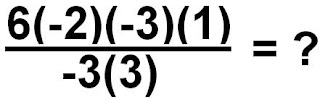
Number 3 is way harder than the previous questions since it includes dividing. Before we divide we must come up with one integer on the top and one integer on the bottom. Once again, I just divided the question in parts to make it easier.
6(-2) (-3)(1)
───────── = ?
(-12) (-3)
─────── = ?
(-9)
Now answer the top part of the fraction/division sign.
'Remove 12 groups of negative 3'. What does that give you?
(-36)
──── = ?
(-9)
What would that question be; quotative, partitive, or multiplicative inverse?
If you guessed quotative, then you're right!
'How many negative nines are in negative 36'?
(-36)
──── = 4
(-9)
Number 4 :

This question I will have to make fairly quick because it's getting late.
(14) + (-6)
──────── = ?
(-4)
Next add the two integers on the top.
(8)
── = ?
(-4)
What would that question be; quotative, partitive, or multiplicative inverse?
If you guessed multiplicative inverse then you're right!
'N x (-4) = (8)'. What is N?
(8)
── = (-2)
(-4)
So, in this scribe I will be talking about the first four questions from the quiz.
Just so you know, if I put something in RED that means that I'm answering it, or that it is the question. If something is in GREEN then that would be the answer to the question.
Number 1 :

I don't know what you did, but instead of subtracting the 11, I added a negative 11.
The question then looked like this :

To solve this question, I split this question into two parts.
The first thing I did was add the negative 3 with the negative 5 which equaled negative 8.
-3 + (-5) = -8
Next I added the negative 8 with the negative 11 which then equaled negative 19.
-8 + (-11) = -19
Number 2 :
Number 2 is not as easy as number 1, but if you had trouble doing this, I will explain how I figured it out.

The first thing I did, was answer whichever pairs I can. So I decided to multiply the 5 and negative 4, and the negative 2 and negative 1.
(5)(-4) + (-2)(-1)(-6) = ?
(-20) + (2) (-6) = ?
To solve the first one, I just remembered the saying that we do when we multiply (look at your barn doors project). '5 groups of negative 4'. You should then know that the answer is negative 20. For the second part that I did, I said the other saying for negative integers at the front. 'Remove 2 groups of negative 1'. And if you did your multiplication homework, you then should know that the answer is negative 2. Anyways, time to finish the equation.
(-20) + (2)(-6) = ?
Two groups of negative six equals ?..
(-20) + (-12) = ? / Negative 12!
Now finish off the question by adding the remaining integers.
(-20) + (-12) = (-32)
Number 3 :

Number 3 is way harder than the previous questions since it includes dividing. Before we divide we must come up with one integer on the top and one integer on the bottom. Once again, I just divided the question in parts to make it easier.
6(-2) (-3)(1)
───────── = ?
-3(3)
To solve this, just use the "rule for multiplying" when you try to figure out a multiplication question. If you did it correctly, your answers should look something like this :(-12) (-3)
─────── = ?
(-9)
Now answer the top part of the fraction/division sign.
'Remove 12 groups of negative 3'. What does that give you?
(-36)
──── = ?
(-9)
What would that question be; quotative, partitive, or multiplicative inverse?
If you guessed quotative, then you're right!
'How many negative nines are in negative 36'?
(-36)
──── = 4
(-9)
Number 4 :

This question I will have to make fairly quick because it's getting late.
(14) + (-6)
──────── = ?
(-4)
Next add the two integers on the top.
(8)
── = ?
(-4)
What would that question be; quotative, partitive, or multiplicative inverse?
If you guessed multiplicative inverse then you're right!
'N x (-4) = (8)'. What is N?
(8)
── = (-2)
(-4)
________________________________________
Anyways, I'm done my scribe. Sorry for it being done so late but I had many distractions along the way. One of them including a nose bleed which really bothered me. So yeah, anyways the next scribe is ... ADRIAN R.! Have fun and good luck.
Oh yeah, please comment and tell me my mistakes so I can make my next scribe better. Thanks in advance!
Oh yeah, please comment and tell me my mistakes so I can make my next scribe better. Thanks in advance!
Dean's Integer Story
Once upon a time in the far off land of Tribalville lived a guy named Bob. He was into dancing, bboying to be specific. He was fairly good at it, but he couldn't hit those hard moves. Bob was tremendously sad, so he decided to take a walk outside and cool off. That's when he saw it. There was a poster pinned onto a electricity pole. It read, "ABC, A Bboy Competition, sign up today! Call 123-4567 for details." He got out his cell and called right away. Bob thought that this was a great opportunity to try out new things.
On the day of the competition, Bob was all pumped up and ready for whatever came at him. When he arrived at the building, Bob wanted to try some new stuff before he battled. As he was about to try some new stuff, the attendant stopped him. She said that he was up first and had to be there as soon as possible. So instead of practicing he decided to try and wish. He said "If anyone can hear me, I wish I would be better at bboying." At an instant, a green fog appeared, and right in front of him stood a genie. The genie said "My young boy, if you want the moves you wish for, you must answer this. He stuck out his index finger, and drew an equation in mid air (and somehow it worked).
(+8) + (-4) = ?
Bob remembered integers when he was a few years younger so this was no problem for him. He simply drew in the air the answer.

The genie was astounded at his work so he granted him his wish. At that moment, Bob felt a little more confident just because he knew he could bboy better than before. During the battle Bob pulled off some really good moves, and ended up winning that one battle with flying colours. Even if he won one battle, it wasn't enough to win the whole competition.
His next battle determined who went into the semi-finals. If he wanted to win he would have to step his game up. He called upon the genie by saying "I wish I could do better at bboying."
Once again, the green fog appeared and the genie came and started talking. Obnoxiously the genie said "What do you want now?"
Bob replied by saying, "I want to be better at bboying please." The genie was very annoyed for his calling but it was his job so he had to do it.
"Alright then." the genie said. Answer this question.
(+4) + (+9) = ?
Before Bob could answer the genie said "This time, you can't use dots."
Bob was in shock because that was the easiest way. He thought hard and tried to think of a different way to solve the equation. He remembered, number lines!

The genie was flabbergasted at the accomplishment of Bob. The genie decided that Bob did deserve to be better. At once, the genie granted him his wish and once again Bob was better than before. Just as the genie went away, the battle started.
Bob was astounded at what he could do now. He could do crazy powermoves at the clap of a hand. When it was his turn to do his set, he did swipes, windmills, all of the basic powermoves. The end result was Bob winning yet again. Bob was jubilant at the thought of him winning, but to do that he would definitely have to do better. The competition he was in consisted of some of the best bboys around.
Bob was freaking out because he knew that the next bboy he was about to battle was 10 times better. He decided to call the genie again. "I wish I can be better at bboying" Bob said for the third time.
The green fog appeared as usual, and the genie appeared. He seemed to be very grumpy as he decided not to greet Bob. All he said was "What now?"
Bob said "genie, can you make me better at bboying yet again?"
The genie replied by saying "Young Bob, you are already very good and if you want to become even better, you must answer this question. Although, the question will be tough. You cannot solve it by using a number line or dots. You must find one other way. That being said, your question is this.
(-17) + (+17) = ?
Bob was shocked. He couldn't use a number line or dots. Those two were the only two he could think of. He sat there thinking very hard. "The numbers are pretty big, but they are opposites. What could I do with an opposite?" he thought. He remembered at an instant. "Zero pairs!" he shouted.

The genie was once again, flabbergasted. Even so, the genie seemed to be smiling in an evil way. He started laughing crazily. The genie started talking "Now that I gave you your 3 wishes, I get a favour in return.
Bob was in shock, and said "you didn't tell me that! That's not fair genie."
The genie replied, "that's the whole point to this, be careful for what you wish for because you might have to do something in return. I gave you your wish, now it's my turn."
TO BE CONTINUED.
On the day of the competition, Bob was all pumped up and ready for whatever came at him. When he arrived at the building, Bob wanted to try some new stuff before he battled. As he was about to try some new stuff, the attendant stopped him. She said that he was up first and had to be there as soon as possible. So instead of practicing he decided to try and wish. He said "If anyone can hear me, I wish I would be better at bboying." At an instant, a green fog appeared, and right in front of him stood a genie. The genie said "My young boy, if you want the moves you wish for, you must answer this. He stuck out his index finger, and drew an equation in mid air (and somehow it worked).
(+8) + (-4) = ?
Bob remembered integers when he was a few years younger so this was no problem for him. He simply drew in the air the answer.

The genie was astounded at his work so he granted him his wish. At that moment, Bob felt a little more confident just because he knew he could bboy better than before. During the battle Bob pulled off some really good moves, and ended up winning that one battle with flying colours. Even if he won one battle, it wasn't enough to win the whole competition.
His next battle determined who went into the semi-finals. If he wanted to win he would have to step his game up. He called upon the genie by saying "I wish I could do better at bboying."
Once again, the green fog appeared and the genie came and started talking. Obnoxiously the genie said "What do you want now?"
Bob replied by saying, "I want to be better at bboying please." The genie was very annoyed for his calling but it was his job so he had to do it.
"Alright then." the genie said. Answer this question.
(+4) + (+9) = ?
Before Bob could answer the genie said "This time, you can't use dots."
Bob was in shock because that was the easiest way. He thought hard and tried to think of a different way to solve the equation. He remembered, number lines!

The genie was flabbergasted at the accomplishment of Bob. The genie decided that Bob did deserve to be better. At once, the genie granted him his wish and once again Bob was better than before. Just as the genie went away, the battle started.
Bob was astounded at what he could do now. He could do crazy powermoves at the clap of a hand. When it was his turn to do his set, he did swipes, windmills, all of the basic powermoves. The end result was Bob winning yet again. Bob was jubilant at the thought of him winning, but to do that he would definitely have to do better. The competition he was in consisted of some of the best bboys around.
Bob was freaking out because he knew that the next bboy he was about to battle was 10 times better. He decided to call the genie again. "I wish I can be better at bboying" Bob said for the third time.
The green fog appeared as usual, and the genie appeared. He seemed to be very grumpy as he decided not to greet Bob. All he said was "What now?"
Bob said "genie, can you make me better at bboying yet again?"
The genie replied by saying "Young Bob, you are already very good and if you want to become even better, you must answer this question. Although, the question will be tough. You cannot solve it by using a number line or dots. You must find one other way. That being said, your question is this.
(-17) + (+17) = ?
Bob was shocked. He couldn't use a number line or dots. Those two were the only two he could think of. He sat there thinking very hard. "The numbers are pretty big, but they are opposites. What could I do with an opposite?" he thought. He remembered at an instant. "Zero pairs!" he shouted.

The genie was once again, flabbergasted. Even so, the genie seemed to be smiling in an evil way. He started laughing crazily. The genie started talking "Now that I gave you your 3 wishes, I get a favour in return.
Bob was in shock, and said "you didn't tell me that! That's not fair genie."
The genie replied, "that's the whole point to this, be careful for what you wish for because you might have to do something in return. I gave you your wish, now it's my turn."
TO BE CONTINUED.
Scribe Post For October 08, 2008
In class today we did 3 things. The three things we did were the game titled "Is This Game Fair?", a probability tree, and the race game. Well the race thing was for homework, but everyone should've done that by now. Anyways, I will explain those three things now.
1. Is This Game Fair?
In class, we learned if the game was fair or not. From what we found out, it is NOT fair.
Here are the pictures that we used in class (well something that I wrote down).


From the percents shown, you can obviously see that the opponent has a higher chance of winning. With 2 dice, there are 36 total possible outcomes (T.P.O. shown in the picture). Out of those 36 outcomes, the player has 6 chances to get points. Thus coming with the fraction 6 over 36 (6/36). Although, for the opponent he has 30 chances to get points. So of course, in the game the opponent mostly wins. When the player wins, it is mostly luck.
2. Racing Game


In class, Mr. Harbeck told us to make this game fair and unfair. This game lets us choose the chances for the red or blue to win. The way this game works is with a die. Which means there are six total possible outcomes. So if the game was to be fair, then the possibilities would look something like this :

That picture means, each player (red and blue) would have a 50% chance of winning.
If the game was unfair, then the chances for one of the players would be really low. An example for the game being unfair is something like this :

So now the percents of each player would be ..

From the percents, you can see that blue has a really good chance of winning.
(Be sure to write this down, because I think that this is homework.)
3. Probability Tree
Another thing that we did in class was a probability tree. The items/pictures we used were a coin (H/T) , a spinner with three sides (A,B,C) and another spinner but with 4 sides (A,B,C,D). Here is a picture of what we did.

(Thanks to Kim C., for the picture.)
To calculate the total possible outcomes you figure out the possible outcomes of the 3 objects.
For the coin there are 2 outcomes, for the spinner with 3 sides there are 3 outcomes and for the spinner with 4 sides there are 4 outcomes.
Thus .. 2 x 3 x 4 = 24.
Here is a picture for that equation :

(Thanks to Kim C., AGAIN for the picture)
Probability trees are a great way to show how you found the total possible outcomes.
________________________________________________
Im done, sorry for all the pictures I copied off of the other posts, I just didn't have time to make my own. Please tell me what I did good and what I did wrong, as it will help me to do better next time. That being said, the next scribe is .. -drum roll- JOSEPH!
Good luck to the next scribes!
1. Is This Game Fair?
In class, we learned if the game was fair or not. From what we found out, it is NOT fair.
Here are the pictures that we used in class (well something that I wrote down).


From the percents shown, you can obviously see that the opponent has a higher chance of winning. With 2 dice, there are 36 total possible outcomes (T.P.O. shown in the picture). Out of those 36 outcomes, the player has 6 chances to get points. Thus coming with the fraction 6 over 36 (6/36). Although, for the opponent he has 30 chances to get points. So of course, in the game the opponent mostly wins. When the player wins, it is mostly luck.
2. Racing Game
In class, Mr. Harbeck told us to make this game fair and unfair. This game lets us choose the chances for the red or blue to win. The way this game works is with a die. Which means there are six total possible outcomes. So if the game was to be fair, then the possibilities would look something like this :

That picture means, each player (red and blue) would have a 50% chance of winning.
If the game was unfair, then the chances for one of the players would be really low. An example for the game being unfair is something like this :

So now the percents of each player would be ..

From the percents, you can see that blue has a really good chance of winning.
(Be sure to write this down, because I think that this is homework.)
3. Probability Tree
Another thing that we did in class was a probability tree. The items/pictures we used were a coin (H/T) , a spinner with three sides (A,B,C) and another spinner but with 4 sides (A,B,C,D). Here is a picture of what we did.

(Thanks to Kim C., for the picture.)
To calculate the total possible outcomes you figure out the possible outcomes of the 3 objects.
For the coin there are 2 outcomes, for the spinner with 3 sides there are 3 outcomes and for the spinner with 4 sides there are 4 outcomes.
Thus .. 2 x 3 x 4 = 24.
Here is a picture for that equation :

(Thanks to Kim C., AGAIN for the picture)
Probability trees are a great way to show how you found the total possible outcomes.
________________________________________________
Im done, sorry for all the pictures I copied off of the other posts, I just didn't have time to make my own. Please tell me what I did good and what I did wrong, as it will help me to do better next time. That being said, the next scribe is .. -drum roll- JOSEPH!
Good luck to the next scribes!
Dean's Measures of Central Tendency
Mean

Median

Mode
Range

Here is a video that explains mean, median and mode :
- Arrange the data in ascending numerical order.
- Add up all the data.
- Divide the sum by how many pieces of data there are.

Median
- Arrange the data in ascending numerical order.
- Cross out the border numbers until you remain with one.
- In the occasion of there being 2 numbers, you add them and then divide by 2.

Mode
- Arrange the data in ascending numerical order.
- Find the most occurring number.
- Note that it is possible to have more than one mode.

( I guess this one is the same as the last picture. )
Range
- Arrange the data in ascending numerical order.
- Subtract the lowest number from the highest number.

Here is a video that explains mean, median and mode :
Subscribe to:
Comments (Atom)

